Mar 27, 2023 · Nuraini Juliastuti
Puteri (she/her) – Our Rat, Narrator, Storyteller
The stories of Puteri, Our Rat, traverse across multiple trajectories, paths and the folded worlds of the past, present and future. Within Indonesian conventional storytelling practices, storytellers are imagined as male storytellers. Thus, they retain a male authoritarian gaze, which includes the colonial gaze. This is also true of the wayang (shadow puppet theatre) tradition, where the storytellers and puppet masters known as dalang are almost exclusively male.
In light of this, I present Puteri: a female rat storyteller. Puteri (also spelled ‘putri’) is an Indonesian and Javanese word which means princess or girl. Puteri’s stories will thus contrast with those that have come before. The protagonists in her stories will not be easily gendered and boxed into certain categories. The stories will demonstrate the unification of multiple beings, or the promises and failures to achieve that.
In light of this, I present Puteri: a female rat storyteller. Puteri (also spelled ‘putri’) is an Indonesian and Javanese word which means princess or girl. Puteri’s stories will thus contrast with those that have come before. The protagonists in her stories will not be easily gendered and boxed into certain categories. The stories will demonstrate the unification of multiple beings, or the promises and failures to achieve that.
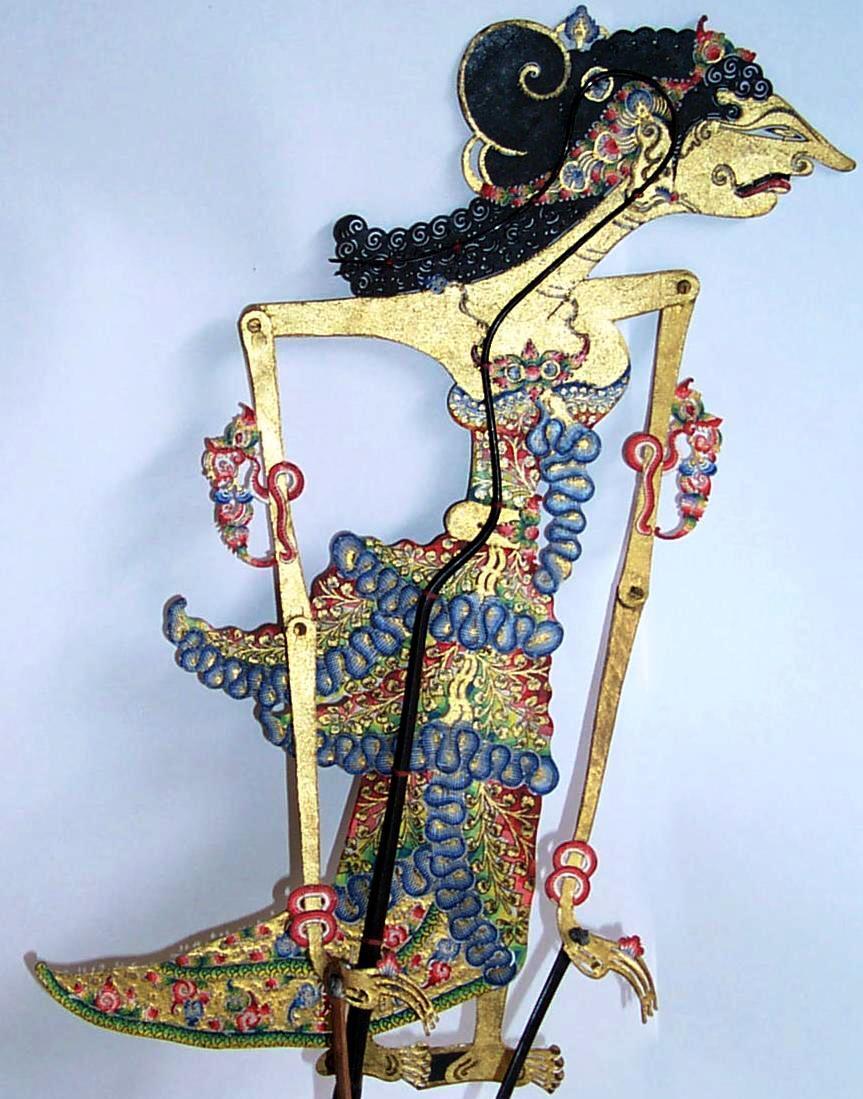
Wayang Srikandi, the symbol of gender fluidity in the Javanese wayang tradition. Srikandi was born as male, and then transitioned into female. Source: JV01Catur Rini, CC BY-SA 3.0, via Wikimedia Commons.
From her nest, deep in the paddy field across the Nglanggeran jungle (Alas Nglanggaren) in Gunung Kidul (Special Region of Yogyakarta), she narrates about various lives, histories and perspectives. Inheriting the feelings, anxieties and glories from many generations of rats, Puteri develops good connections with other rats who live and invest in different dwelling places — people’s houses, certain restaurants or warung, in the markets, under the trees, at an old cemetery or at the bank of the river.
Puteri is a sociable rat, a cosmopolitan being. Her circle of friends is not only limited to rats, but also includes long-tailed monkeys, dogs, canthel (Javanese sorghum), paddy (of course), and human beings. Puteri likes traveling to other places and listening to the stories told by her elders. Such stories narrate how the rats travel to various places, far from their original homes.
Rats are often portrayed as the common enemy of the farmers. Some panels in the Karmawibhangga relief in the Borobudur temple show how earlier farmers guarded their paddy fields from the rats’ attacks, working together with their dogs. This relief also shows the way in which farmers combatted rats. They burnt coconut leaves, then directed the smoke to the rats’ nests and holes underground. (1) Smoking the rats’ nests proved to be a source of inspiration for contemporary farmers. In English, the common expression ‘to smoke out the rats’ is used to refer to getting rid of criminals or corrupt officials.
Puteri is a sociable rat, a cosmopolitan being. Her circle of friends is not only limited to rats, but also includes long-tailed monkeys, dogs, canthel (Javanese sorghum), paddy (of course), and human beings. Puteri likes traveling to other places and listening to the stories told by her elders. Such stories narrate how the rats travel to various places, far from their original homes.
Rats are often portrayed as the common enemy of the farmers. Some panels in the Karmawibhangga relief in the Borobudur temple show how earlier farmers guarded their paddy fields from the rats’ attacks, working together with their dogs. This relief also shows the way in which farmers combatted rats. They burnt coconut leaves, then directed the smoke to the rats’ nests and holes underground. (1) Smoking the rats’ nests proved to be a source of inspiration for contemporary farmers. In English, the common expression ‘to smoke out the rats’ is used to refer to getting rid of criminals or corrupt officials.
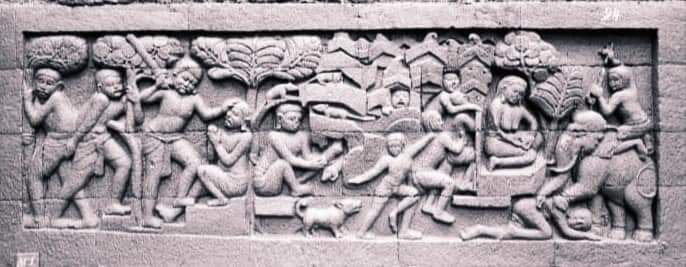
Smoking the rat nest, as seen in the Borobudur relief. Source: Borobudur Writers and Cultural Festival.
Between 1911 and 1936, still during the colonial era, rats helped spread a plague. The Dutch officials stated that the plague was facilitated by the unhygienic architectural design of traditional Javanese houses, believed to be prone to be used by rats as a dwelling. However, in Malang (East Java), a city which was heavily impacted by a famine at that time, the rats did not come from the houses but from the rice that the Dutch colonial state imported from Myanmar in an attempt to solve the famine. Rats travelled along with the rice and started to breed uncontrollably. (2)
Rats always migrate from one location to another. Diseases always travel. But who has the power to control narratives around a specific disease? Rats are always the ones who get to be blamed.
Various fables, however, portray rats as characters with impressive skills. Rats are good at being quiet, hard-working creatures, saving things which are worthy of collecting. In English, there is the expression ‘cunning like a rat’: which is both complimentary and suggesting of a sinister or devious behaviour. In the Javanese context, this is illustrated through the story of how the remnants of a royal spa were discovered by the villagers in Temon village, Mojokerto (East Java) in 1914. No one realised that what was buried under the paddy field was a royal spa, until some farmers tried to chase the rats down to their nest. The digging activity led to the discovery of the royal spa. The location of the spa is not far from the Bajangratu Temple, part of the Majapahit Empire. The spa must have been one of the facilities of the empire. This shows quite well the rats’ abilities of being quiet, doing their own things, and saving/protecting things which are worthy of collecting.
Despite these good traits are being acknowledged, the ‘great rat hunt’ (3) continues. Though now, instead of burning coconut leaves to eliminate their nests, farmers have started to employ pesticides, having a broad detrimental impact on the ecosystem. From time to time, newspapers report about how farmers in different villages seek to combat rats, equalized to pests. This kind of news rarely makes headlines though, they are side-lined into the regional columns, the inside pages. These pages narrate the everyday realities of farmers and rats, ‘who all deserve to die.’ It is a story of constant battle. Looking at the photos which accompany such news, the battles feel real. Oftentimes the rat killing event is organised by the village authorities and covers the rice fields belonging to many people. Farmers, villagers, village heads, and military officers (somehow there always has to be military officers involved in this) are the usual figures to appear in the photos. They gather in a crowd and walk around the border of the field, carrying the spraying tools, which look like guns. When the killing is over, the participants take photos. Piles of dead rats are placed on the edge of the field. In some photos, some farmers show off the dead rats. They hold the tails, with the rats’ heads hanging upside down. The rats look like rat puppets. The green rice field stays on the background, interspersed with banners stating ‘Gropyok Tikus Bersama’ (Getting rid of the rats together) or ‘Pemberantasan Tikus Massal’ (The Mass Rat Eradication).
There is a long-standing belief among farmers in Gunung Kidul that the field rats are the incarnation of the soldiers of the Nyi Roro Kidul — the spirit queen of the Southern Ocean. (4) According to this belief, the rats’ season begins when the foam from the Southern Ocean reaches the shore. As a form of respect, some farmers try not to be overly confrontational with the rats. They refer to the rats as Den Baguse, which can be translated, though it sounds ironic, as ‘Mister Charming’.
Rats always migrate from one location to another. Diseases always travel. But who has the power to control narratives around a specific disease? Rats are always the ones who get to be blamed.
Various fables, however, portray rats as characters with impressive skills. Rats are good at being quiet, hard-working creatures, saving things which are worthy of collecting. In English, there is the expression ‘cunning like a rat’: which is both complimentary and suggesting of a sinister or devious behaviour. In the Javanese context, this is illustrated through the story of how the remnants of a royal spa were discovered by the villagers in Temon village, Mojokerto (East Java) in 1914. No one realised that what was buried under the paddy field was a royal spa, until some farmers tried to chase the rats down to their nest. The digging activity led to the discovery of the royal spa. The location of the spa is not far from the Bajangratu Temple, part of the Majapahit Empire. The spa must have been one of the facilities of the empire. This shows quite well the rats’ abilities of being quiet, doing their own things, and saving/protecting things which are worthy of collecting.
Despite these good traits are being acknowledged, the ‘great rat hunt’ (3) continues. Though now, instead of burning coconut leaves to eliminate their nests, farmers have started to employ pesticides, having a broad detrimental impact on the ecosystem. From time to time, newspapers report about how farmers in different villages seek to combat rats, equalized to pests. This kind of news rarely makes headlines though, they are side-lined into the regional columns, the inside pages. These pages narrate the everyday realities of farmers and rats, ‘who all deserve to die.’ It is a story of constant battle. Looking at the photos which accompany such news, the battles feel real. Oftentimes the rat killing event is organised by the village authorities and covers the rice fields belonging to many people. Farmers, villagers, village heads, and military officers (somehow there always has to be military officers involved in this) are the usual figures to appear in the photos. They gather in a crowd and walk around the border of the field, carrying the spraying tools, which look like guns. When the killing is over, the participants take photos. Piles of dead rats are placed on the edge of the field. In some photos, some farmers show off the dead rats. They hold the tails, with the rats’ heads hanging upside down. The rats look like rat puppets. The green rice field stays on the background, interspersed with banners stating ‘Gropyok Tikus Bersama’ (Getting rid of the rats together) or ‘Pemberantasan Tikus Massal’ (The Mass Rat Eradication).
There is a long-standing belief among farmers in Gunung Kidul that the field rats are the incarnation of the soldiers of the Nyi Roro Kidul — the spirit queen of the Southern Ocean. (4) According to this belief, the rats’ season begins when the foam from the Southern Ocean reaches the shore. As a form of respect, some farmers try not to be overly confrontational with the rats. They refer to the rats as Den Baguse, which can be translated, though it sounds ironic, as ‘Mister Charming’.
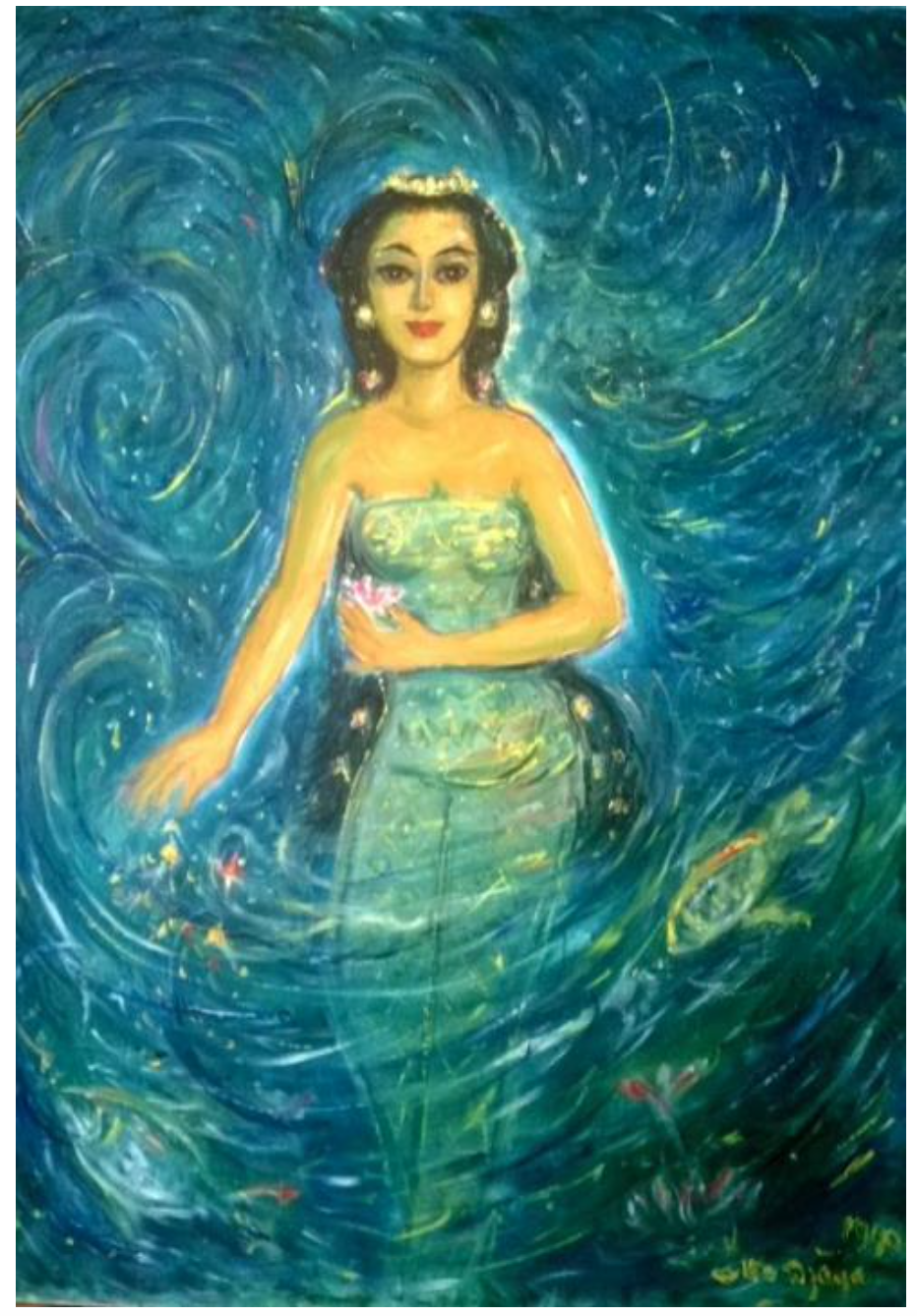
Nyi Roro Kidul. Ratu Pantai Selatan (Nyi Roro Kidul. Queen of the Southern Ocean), painting by Otto Djaja, 1990. Source: Inge-Marie Holst & Hans Peter Holst, Otto Djaja, 1916-2002. Indonesia’s remarkable painter and storyteller. The Chronicle, published by the Indonesian Visual Art Archive, 2019, and available here.
Rather than killing the rats, they provide a special offering to them, tiwul, a culinary specialty from the Gunung Kidul area. (5) Tiwul is a dish made from ground cassava. It can be made into a sweet or savoury dish (as a substitute for rice). Such a belief is usually regarded as a myth, and a disadvantage to the life of the farmers. It is regarded as a disadvantage because the farmers who uphold this belief refuse to kill the rats, and instead share their crops with them. On the other hand, the myth also opens up possibilities to see the conflict between humans and animals in a different light. In perceiving the rats as the incarnation of the soldiers of Nyai Roro Kidul, the myth envisions the rats as beings who live in between real and mythical worlds. Total victory is pointless. The most important thing is to seek balance.
The meaning of rats is constantly shaped socially, materially, and cosmologically. This shifting production of meanings is what shapes Puteri’s perspectives. Her stories will tell how rats navigate their lives in ever changing social environments and, as the story will make clear later, Puteri seems to be drawn to other companions who are always regarded as the invader.
The meaning of rats is constantly shaped socially, materially, and cosmologically. This shifting production of meanings is what shapes Puteri’s perspectives. Her stories will tell how rats navigate their lives in ever changing social environments and, as the story will make clear later, Puteri seems to be drawn to other companions who are always regarded as the invader.
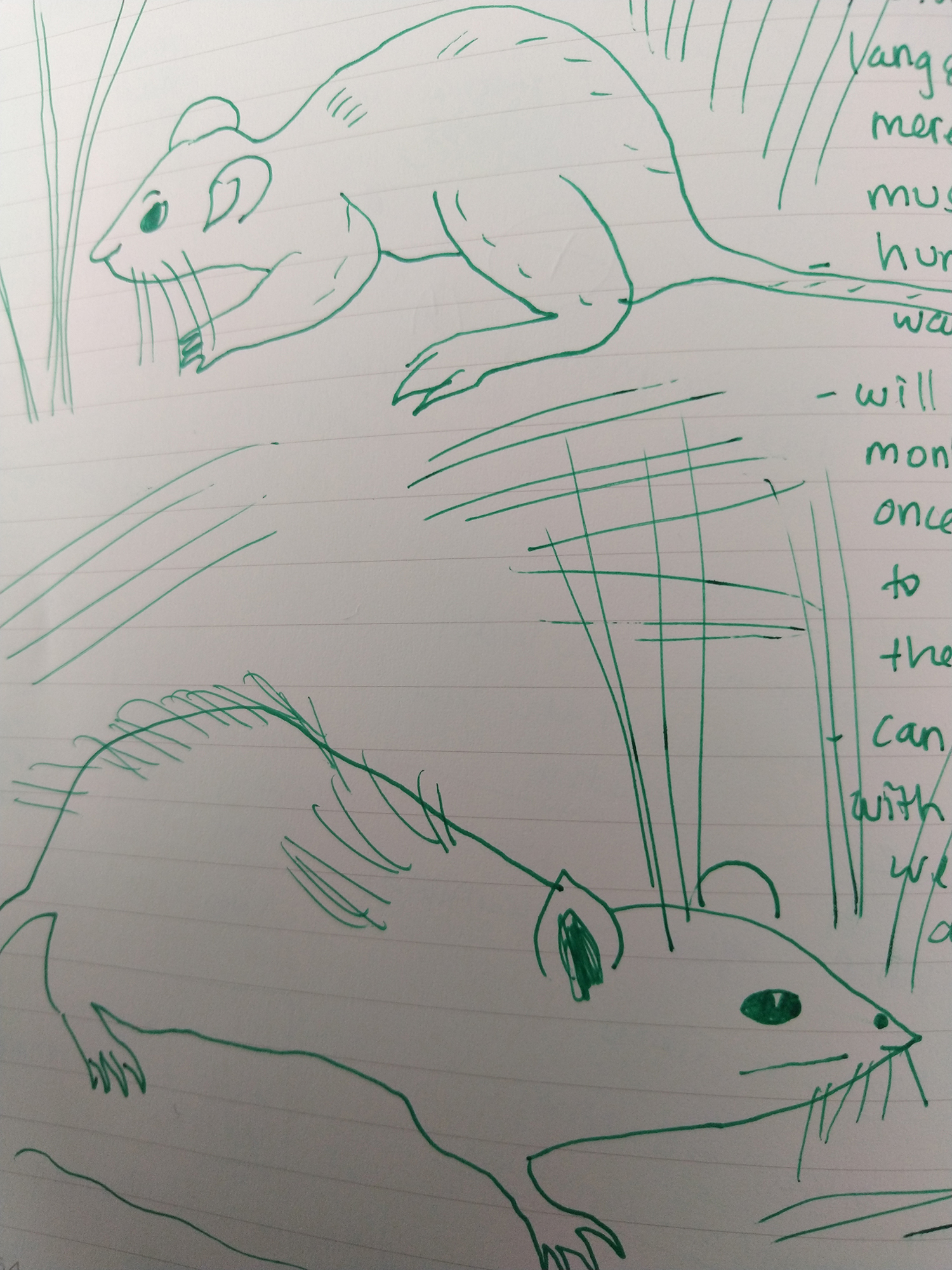
Learning how to draw Puteri. Drawing: the author.
- To see the Borobudur panels, see here: borobudurwriters.id and catalogue.leidenuniv.nl (accessed 30 June 2022).
- See Syefri Luwis, Epidemi Penyakit Pes di Malang 1911-1916 (The Bubonic Plague Epidemic in Malang 1911-1916) (Temanggung: Penerbit Kendi, 2020).
- The phrase ‘Great rat hunt’ emerged because I was inspired by The Great Hanoi Rat Hunt: Empire, Disease and Modernity in French Colonial Vietnam by Michael G Vann (author) and Liz Clarke (illustrator) (New York: Oxford University Press, 2019).
- As a starting point to understand the meaning of Nyai Roro Kidul, see Robert Wessing, ‘A princess from Sunda: Some aspects of Nyai Roro Kidul, the divine female in Indonesia’, Asian Folklore Studies 56(2) (1997), pp.317-353.
- Though thiwul is always seen as inferior to rice, Wonggunung observes that thiwul is also regarded to represents the true resilient personality of Gunung Kidul people. See Wonggunung, Gunungkidulan: Gunungkidul, antara Manusia, Arkeo-Narasi, Kosmologi, dan Mitologi (Gunungkidulan: Gunungkidul, Human, Archeo-Narratives, Cosmology and Mithology), (Yogyakarta: Baturagung, 2018), pp. 393-399.